





Keyword Density Analyzer
Audit your content like Ahrefs — fast, visual, and actionable.
| # | Keyword | Count | Density | Status |
|---|
Keyword Density Analyzer Online
Ever written a blog post or webpage and wondered if you are using your target keyword too many times — or not enough? Our free online keyword density analyzer instantly scans your content and tells you exactly how often each keyword appears, what percentage of your total word count it makes up, and whether you are at risk of keyword stuffing. Whether you are an SEO professional, a content writer, a blogger, or a business owner — this tool gives you clear, actionable insights in seconds. No software to install. No account. No guesswork.
No downloads. No signup. No ads. Just paste your content or enter a URL and get your keyword density report instantly.
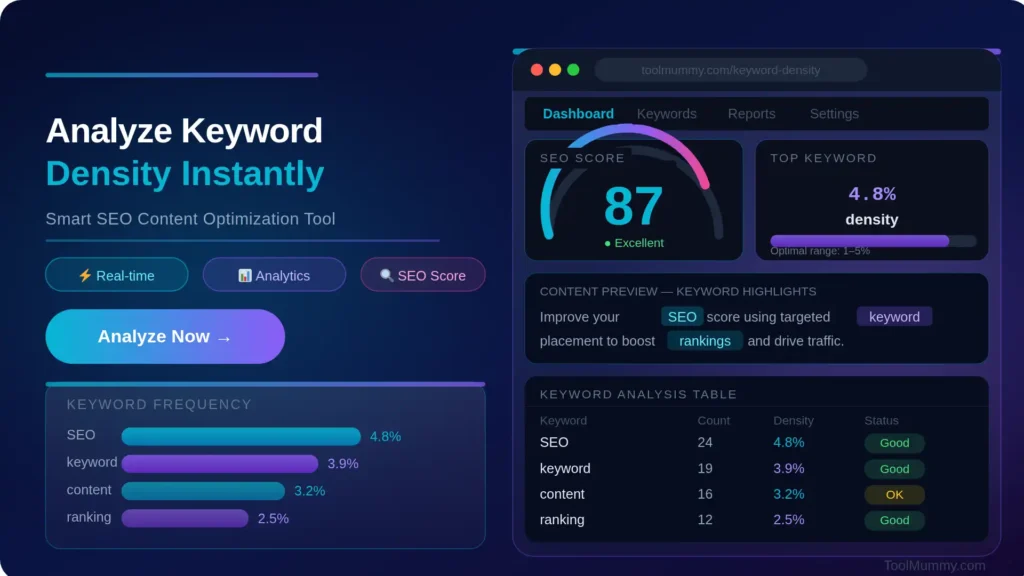
How to Use This Keyword Density Analyzer
Analyzing your keyword density is simple. Here is how it works:
Step 1 — Paste Your Content or Enter a URL
Either paste your article, blog post, or webpage content directly into the text area, or enter a URL and the tool will automatically fetch and analyze the content of that page.
Step 2 — Set Your Target Keyword (Optional)
If you want to check a specific keyword, enter it in the keyword field. The tool will highlight its frequency and density separately. Leave this blank to get an analysis of all keywords in your content.
Step 3 — Click Analyze
Hit the Analyze button. The tool processes your content instantly and generates a complete keyword density report — sorted by frequency, showing density percentages, and flagging any over-used terms.
Step 4 — Review and Optimize
Review the results. If a keyword appears too frequently, reduce its usage and replace some instances with synonyms or related phrases. If your target keyword appears too rarely, add it naturally in a few more places.
What you will see:
- Total word count of your content
- Frequency of every keyword (how many times it appears)
- Density percentage for each keyword
- 1-word, 2-word, and 3-word phrase analysis
- Keyword stuffing warnings for over-used terms
- Your target keyword’s rank in the density report
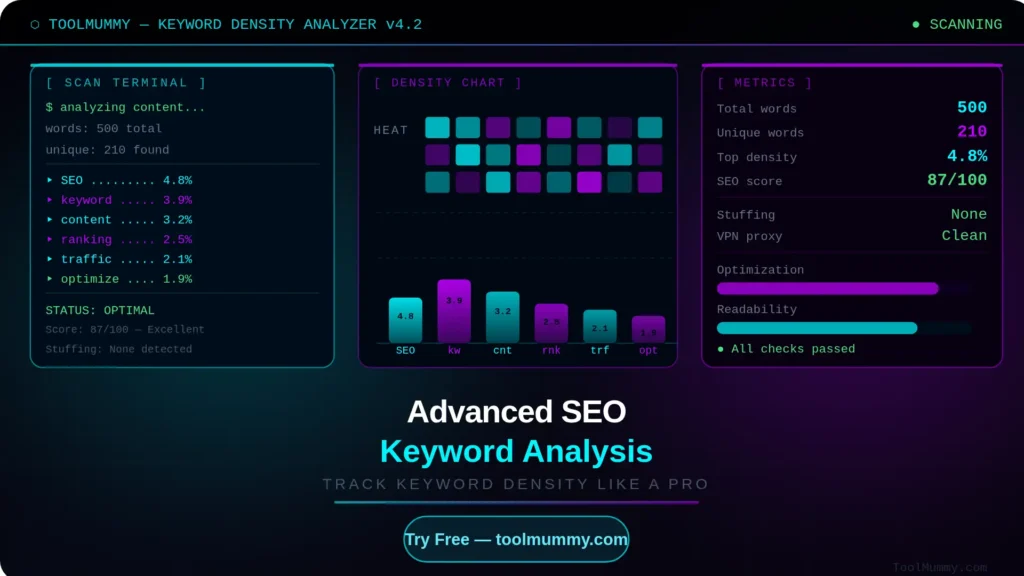
What Makes This Keyword Density Analyzer Different?
Most keyword density tools just count how many times a word appears. Ours gives you the complete picture — single keywords, 2-word phrases, 3-word phrases, and smart warnings — so you can optimize with confidence.
Analyzes Single Words and Multi-Word Phrases
Most tools only count single keywords. Ours analyzes 1-word, 2-word, and 3-word keyword combinations simultaneously — helping you discover natural long-tail keyword usage in your content and identify phrases that may be accidentally over-repeated.
Keyword Stuffing Warning
If any keyword or phrase exceeds a safe density threshold, the tool flags it with a warning — before you publish and before Google penalizes you. This protects your content from over-optimization penalties that can tank your rankings.
URL Analysis — Check Any Webpage
Enter any URL and the tool automatically fetches and analyzes the keyword density of that page. This is powerful for competitive analysis — see exactly which keywords your competitors are targeting and how often they use them.
Target Keyword Focus Mode
Enter your specific target keyword and get a focused report showing exactly where it stands — its frequency, density percentage, and whether you need to increase or reduce its usage to hit the optimal range.
Stop Words Filtered Automatically
Common words like “the,” “is,” “and,” “a” are automatically excluded from the analysis. Only meaningful, SEO-relevant keywords are counted — giving you a clean, accurate picture of your actual keyword usage.
Completely Free — No Signup
No account, no credit card, no hidden charges. Analyze as many pieces of content as you need, as many times as you want — completely free.
Who Uses a Keyword Density Analyzer?
A keyword density checker is an essential tool for anyone who creates content for the internet — from beginners writing their first blog post to enterprise SEO teams managing hundreds of pages.
SEO Professionals
SEO specialists use keyword density analyzers during content audits to identify pages that may be keyword stuffed or under-optimized. They also use it for competitive analysis — checking competitor pages to understand their keyword targeting strategy before creating rival content.
Content Writers and Bloggers
Writers use it to check their finished articles before publishing — making sure the target keyword appears naturally throughout the content without being repeated so many times that it reads awkwardly or triggers Google’s spam filters.
Digital Marketing Agencies
Agencies use it when onboarding new clients to audit existing content, identify over-optimized pages that may be suffering ranking penalties, and create optimization recommendations for their SEO reports.
Website Owners and Business Owners
Business owners managing their own website use it to check their homepage, service pages, and product descriptions — ensuring they are including the right keywords at the right frequency without accidentally over-stuffing.
Students Learning SEO
For students and beginners learning SEO, a keyword density analyzer is one of the first practical tools to understand on-page optimization. Seeing the numbers in black and white makes keyword usage concepts click instantly.
E-commerce Store Owners
Product descriptions on Shopify, WooCommerce, and Amazon need to include relevant keywords naturally. Too few and the product does not rank. Too many and it reads like spam. A keyword density check before publishing keeps product pages in the sweet spot.
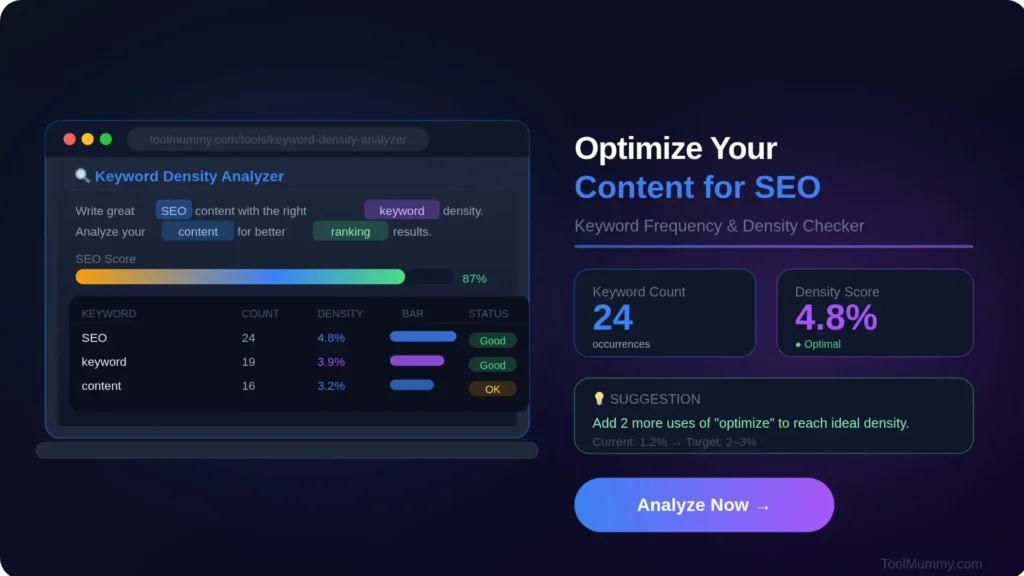
Keyword Density Guide — Safe Ranges for Different Content Types
There is no single perfect keyword density number. It depends on your content type, your industry, and what top-ranking competitors are doing. Here is a practical reference guide based on industry research:
| Content Type | Recommended Density | Stuffing Risk Above | Notes |
|---|---|---|---|
| Blog Post / Article | 0.8% – 1.5% | Above 3% | Use synonyms and related terms throughout |
| Landing Page / Sales Page | 1.0% – 2.0% | Above 4% | Keyword in H1, first paragraph, and CTA |
| Product Description | 1.0% – 2.5% | Above 5% | Natural repetition acceptable for product names |
| Category Page | 1.0% – 2.0% | Above 4% | Spread keyword across headers and intro text |
| Homepage | 0.5% – 1.5% | Above 3% | Brand keywords are fine at higher frequencies |
| FAQ Page | 0.5% – 1.2% | Above 2.5% | Keyword appears naturally in questions and answers |
Important: These are guidelines, not rules. Google does not penalize based on an exact density number. What matters is that your keyword usage feels natural when read aloud. If a sentence sounds unnatural because a keyword appears too often, rewrite it — readability always beats density targets.
What Is Keyword Density? — Explained Simply
Keyword density is the percentage of times a specific keyword or phrase appears in your content compared to the total number of words on the page. It is one of the oldest on-page SEO concepts and still plays a role in how search engines understand what your content is about.
The Keyword Density Formula
The formula is simple: Keyword Density (%) = (Number of times keyword appears ÷ Total word count) × 100 For example, if the keyword "SEO tips" appears 8 times in a 500-word article: (8 ÷ 500) × 100 = 1.6% That is a healthy, natural density. Our tool calculates this instantly for every keyword in your content — no manual counting needed.
What Is Keyword Stuffing — and Why Is It Dangerous?
Keyword stuffing is the practice of excessively repeating a keyword in an attempt to manipulate search rankings. For example, writing "Buy cheap shoes online. Our cheap shoes online store has the best cheap shoes online deals for cheap shoes online buyers" is keyword stuffing. Google's algorithms — especially after the Panda update — actively detect and penalize pages with unnatural keyword repetition. Stuffed pages lose rankings, traffic, and can even be removed from Google's index entirely. Our tool flags this risk before it happens.
Does Keyword Density Still Matter for SEO in 2026?
Yes — but differently than it used to. Google no longer rewards pages simply for mentioning a keyword more times. Modern Google uses Natural Language Processing (NLP) technology like BERT and MUM to understand content contextually. However, keyword density still matters for two reasons: first, including your target keyword at a reasonable frequency helps Google confirm what your page is about; second, avoiding keyword stuffing prevents ranking penalties. The sweet spot is natural, readable content where your keyword appears consistently but not obsessively.
TF-IDF — The Advanced Version of Keyword Density
TF-IDF stands for Term Frequency–Inverse Document Frequency. It is a more sophisticated version of keyword density that compares how often a term appears in your content relative to how often it appears across all documents on the web. High TF-IDF score means your page gives special emphasis to a term compared to the average page — which signals strong topical relevance to search engines. Tools like Semrush and Ahrefs use TF-IDF for advanced content optimization. Our keyword density analyzer is a practical, free starting point for understanding keyword usage before moving to advanced tools.
Frequently asked questions
Everything you need to know about our free online keyword density analyzer.